A Single Small Miner Against the Power Bill
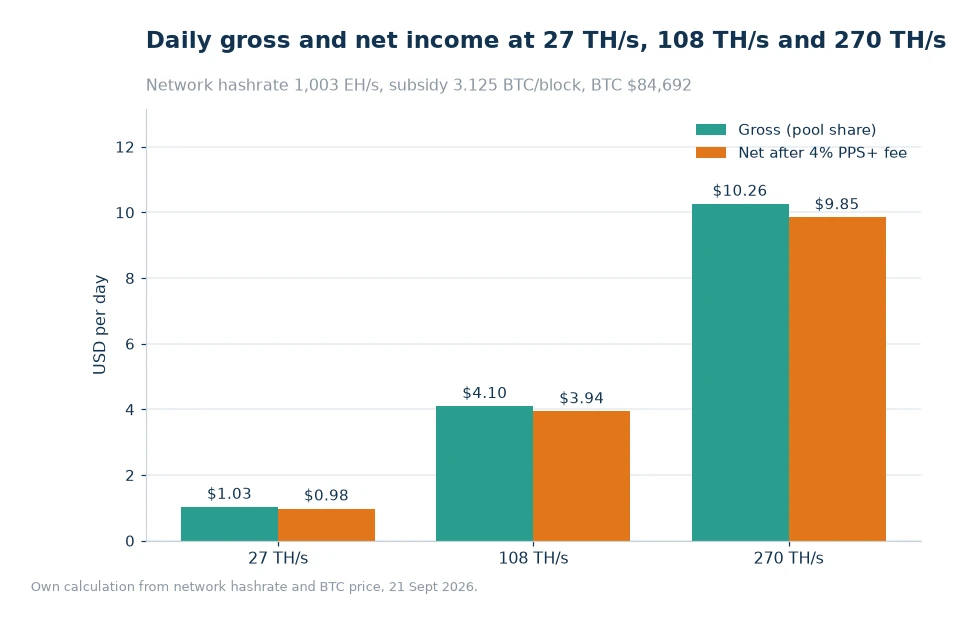
One 27 TH/s unit credits 1.211e-05 BTC a day at current network figures, which is $1.03 gross and $0.98 once the listed 4% comes off the block-reward part. Run it at 20 joules per terahash on a $0.06 tariff and the power bill is $23.33 a month against $29.40 of settled credit. The margin is real but thin, and the meter decides whether it exists at all.

Key takeaways
- 27 TH/s earns $1.03 a day gross and $0.98 settled; 270 TH/s earns $10.26 and $9.85.
- At 20 J/TH and $0.06 per kWh, the smallest unit spends $23.33 a month on power.
- Every cent added to the tariff costs the 270 TH/s setup about $38.88 a month.
- A smaller unit is more exposed to fixed costs, because the same meter reading is spread over fewer coins.
The box on the shelf
Small miners get advice written for farms: buy in bulk, negotiate power, hire a technician. None of it applies to one machine in a spare room. What applies is a much narrower question, whether the coins credited each day are worth more than the electricity consumed each day at the rate printed on the bill. Everything else is secondary at this scale.
The arithmetic is unforgiving because both sides are small. A 27 TH/s unit produces a little over a dollar of credit daily; a fan, a controller and a hash board drawing 540 watts consume roughly 13 kWh in the same period. At six cents that is 78 cents. At twelve cents it is $1.56 and the credit no longer covers it. The machine did not change, and neither did the network. Only the tariff moved.
What the tariff does to a small credit
Residential rates are rarely a single number. There is often a standing charge, a tiered rate that rises with use, and in some places a time-of-use schedule that punishes evenings. A miner running continuously pays the average of all of it, not the headline rate, and the standing charge arrives whether the machine runs or not.
That is why a miner should test with a meter rather than a calculator for the first month. A plug-in meter costs less than a fortnight of the smallest unit's revenue and answers the questions a calculator cannot: what the machine actually draws at the wall after the power supply loses its share, how hot the room gets, and whether the fan noise is tolerable at 2 a.m. Those answers decide whether a second unit is a good idea far more reliably than a spreadsheet does.
The credit side has its own small print, and ViaBTC Crypto Mining publishes it rather than hiding it in a dashboard. Settlement is hourly under PPS+, so the balance moves in steps rather than in one monthly lump, and the listed charge is 4% of the block-reward component rather than 4% of everything. At this scale the difference between the two readings is a few cents a day, which is exactly why it is easy to ignore and worth understanding before scaling up.
Three sizes of the same decision
Scaling a small operation usually means adding identical units, so the numbers below step by a factor of four and then 2.5. The power column assumes 20 joules per terahash throughout and a flat $0.06 per kWh, with no standing charge included.
| Capacity | Settled per day | Settled per month | Power per month | Left over |
|---|---|---|---|---|
| 27 TH/s | $0.98 | $29.40 | $23.33 | $6.07 |
| 108 TH/s | $3.94 | $118.20 | $93.31 | $24.89 |
| 270 TH/s | $9.85 | $295.50 | $233.28 | $62.22 |
The "left over" column is not profit. It has to absorb the standing charge, any cooling the room needs in summer, replacement fans and the occasional dead power supply. What the column does show is direction: the absolute gap widens as capacity grows even though the percentage gap stays roughly the same, because both credit and power scale together.
The trap in second-hand small units
Small capacity is often bought second-hand, and the numbers on the listing are the seller's numbers. A unit advertised at 27 TH/s may measure 24 at the wall once the power supply and the ambient temperature are taken into account, and the missing three terahash are worth about 11% of the credit. At this scale that is not a rounding error; it is the margin.
Ask for a screenshot of the machine's own dashboard under load rather than a photograph of the box, and if possible watch it run for twenty minutes. Hashrate that drifts down as the unit warms points to a cooling problem, which becomes your problem the moment it is in the spare room. Listen to the fan at full speed too, because a small unit in a house is judged by its noise as much as by its coins.
Parts matter as much as the board. A cheap unit with an unusual controller or a discontinued fan is cheap for a reason, and a replacement part that takes six weeks to arrive costs more in downtime than the discount saved. The economics of small mining are dominated by uptime precisely because the absolute numbers are small: a week offline at 27 TH/s removes about $7 of credit, which is more than a month's margin.
Finally, check what the seller was actually earning rather than what the listing claims. A unit that has been run at a high tariff may have been losing money for months, which says nothing about its condition but a great deal about whether the asking price reflects the machine or the hope attached to it. Ask how long it has been listed, and treat a listing that has sat for two months as evidence about the price rather than about the hardware.
Worked example
Take the middle unit, 108 TH/s, and carry it from network arithmetic to the monthly remainder.
- Daily network issuance: 3.125 BTC × 144 blocks = 450 BTC.
- Slice per TH/s: 450 ÷ 1,003,000,000 = 0.00000044865 BTC.
- 108 TH/s: 108 × 0.00000044865 = 0.00004845 BTC, which the chart rounds to a $4.10 gross day.
- Gross: 0.00004844 × 84,692 = $4.10.
- Settled: 4.10 × 0.96 = $3.94, the figure in the table.
- Power: 108 × 20 = 2,160 W, or 2.16 kW; over 24 hours that is 51.84 kWh.
- Monthly power: 51.84 × 30 = 1,555.2 kWh; at $0.06 that is $93.31.
- Monthly settled credit: 3.94 × 30 = $118.20, leaving $24.89 before the standing charge and cooling.
Frequently asked questions
Is one small miner worth running at all?
It depends almost entirely on the tariff: at $0.06 per kWh and 20 J/TH the 27 TH/s unit leaves about $6.07 a month after power, while at $0.12 the same unit spends more on electricity than it earns.
How much power does 270 TH/s draw?
At 20 joules per terahash it draws 5,400 W, or 129.6 kWh a day, which costs $233.28 a month at $0.06 per kWh against $295.50 of settled credit.
Should I include the standing charge in the comparison?
Yes, if the mining is the reason the supply exists; a fixed monthly charge divided by a small coin output can be a larger cost than the energy itself, and it does not shrink when the machine idles.
Meter first, expand second
Run the smallest unit for a full billing cycle with a meter in front of it, then compare the measured kilowatt-hours with the credit shown in the pool account. That single comparison tells you the real tariff, the real draw and the real margin, and it costs a month. Only after that does a second unit make sense. The fee schedule explains what is deducted before the credit lands, and the Miner Profitability Ranking shows how other machines compare on efficiency, which is the number that decides whether the meter reading improves when you upgrade.
Sources: ViaBTC pricing, wallet and miner pages. Figures read 21 Sept 2026 at a network hashrate near 1,003 EH/s, difficulty of 132.76 T, 3.125 BTC subsidy, 144 blocks per day and an $84,692 coin price[1]. Published 24 Oct 2026; 20 J/TH and $0.06 per kWh are stated assumptions.